
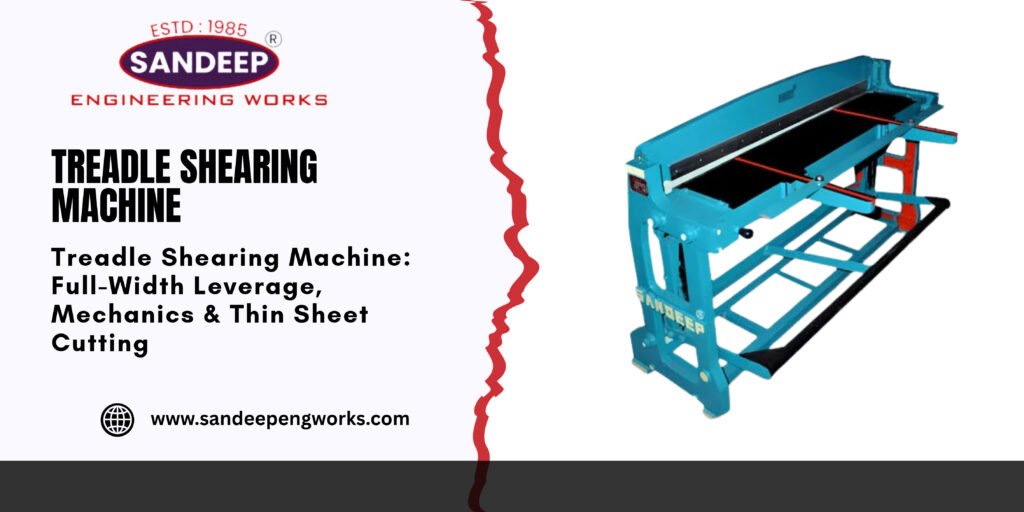
When fabricating wide, light-gauge sheet metal components, maintaining uniform cutting pressure across the entire width of the sheet is critical to preventing edge bowing, corner tearing, and dimensional inaccuracy. A Treadle Shearing Machine is specifically engineered to solve this challenge through a full-width mechanical foot bar that distributes operator force symmetrically to both ends of the upper cutting beam.
Operating entirely on human mechanical leverage without motors, hydraulic pumps, or compressed air lines, the treadle guillotine shear is a cornerstone machine in HVAC ducting workshops, non-ferrous metal fabrication units, switchgear prototyping shops, and technical training institutes. Understanding its full-span linkage mechanics, thin-sheet distortion control, and structural alignment reveals why it excels at high-precision light-gauge cutting.
1. Full-Width Treadle Leverage vs. Single-Pedal Geometry
The defining structural feature of a treadle shear is the continuous horizontal foot bar spanning the full front width between the left and right side housings. While a standard Foot Operated Shearing Machine utilizes a localized pedal lever assembly, the full-width treadle bar offers distinct ergonomic and mechanical advantages when handling wide sheets:
Symmetrical Force Distribution: Because the treadle bar connects directly to twin lever arms at both extremities of the machine, depressing the bar anywhere along its span transmits equal downward pulling force to both the left and right ends of the upper cutting beam. This eliminates uneven twisting torque across the blade beam, even when the operator stands off-center to support a large sheet.
Operator Mobility Along Wide Sheets: When trimming sheets measuring 4 feet, 6 feet, or 8 feet in width, the operator frequently shifts position along the front table to align scribed marks or hold wide overhangs flat. A full-width treadle allows immediate foot actuation from any standing position without forcing the operator to reach awkwardly for a fixed center pedal.
Smooth Compound Mechanical Advantage: The treadle arms pivot on heavy-duty trunnion pins housed in the lower side frames, multiplying downward foot thrust into crisp shearing pressure while counterbalanced helical springs return the cutting beam smoothly to the top of its stroke.
2. Eliminating Edge Distortion on Thin GI, Brass, and Aluminum Sheets
Thin-gauge sheets—such as 24-gauge to 16-gauge Galvanized Iron (GI), soft aluminum, copper, brass, and Cold Rolled Close Annealed (CRCA) steel—behave differently under shear stress than thick plates. Because thin sheets have low inherent bending stiffness, excessive rake angles or loose clamping cause the cut strip to curl, bow, or fold between the blades.
Shallow Precision Rake Angle: Treadle shears are manufactured with a carefully optimized, low-angle upper blade inclination. This shallow rake slices progressively across the sheet while minimizing downward bending deflection, producing flat, straight strips free from helical twist.
Synchronized Hold-Down Clamping: Linked directly to the treadle stroke, a rigid front hold-down bar contacts and clamps the sheet firmly against the lower bed just prior to blade engagement. On thin, slippery materials like polished aluminum or oiled CRCA sheets, this full-width clamping prevents micro-slippage that would otherwise throw off cut squareness.
Micro-Adjusted Blade Clearance: To shear thin non-ferrous metals without leaving rolled burrs, the upper and lower tool-steel blades are ground to tight flatness tolerances and set with minimal horizontal clearance, ensuring clean metal fracture across the entire bed length.
3. Structural Frame Construction and Dimensional Referencing
Long-term cutting accuracy in a manual treadle shear depends on the dimensional stability of its casting and frame assembly:
Close-Grained Cast Iron Housings and Bed: Rigid side frames and a deeply ribbed lower table absorb lateral separating forces generated during the cut, ensuring the center of the upper blade does not bow away from the lower blade.
Adjustable Slideways and Gibs: The upper cutter beam moves within precision-machined vertical guideways equipped with wear-compensating gibs, keeping the blade path strictly perpendicular to the table surface over years of continuous workshop use.
Integrated Squaring Scales and Gauges: Front extension support arms, inlaid millimeter/inch table scales, side squaring guides, and a calibrated rear back gauge allow operators to position thin sheets rapidly and produce identical rectangular blanks with repeatable accuracy.
4. Positioning Treadle Shears Within the Broader Shearing Lineup
Selecting the right machine across the complete family of industrial Shearing Machines depends on matching sheet thickness and batch volume to the appropriate actuation mechanism:
Light-Gauge Manual Precision: For thin sheets up to roughly 1.2 mm to 1.6 mm in custom fabrication, ducting, and non-ferrous work, the treadle shear delivers unmatched control, quiet operation, and zero energy overhead.
High-Volume Continuous Production: When workshops transition from custom batch work to continuous daily production on thicker mild steel or stainless steel sheets (2 mm to 6 mm+), stepping up to a Power Operated Shearing Machine Under Crank provides high strokes per minute and motorized cutting power.
5. Key Industries Served by Treadle Shearing Machines
Because of its clean cold-shearing action and gentle sheet handling, the treadle shear is widely deployed across specialized manufacturing sectors:
HVAC and Ventilation Duct Manufacturing: Cutting lock-forming blanks, collars, and transition pieces from galvanized iron and aluminum sheets without damaging surface zinc coatings.
Electrical Enclosure and Control Box Fabrication: Trimming thin-gauge cover plates, partitions, and mounting panels with burr-free edges safe for assembly workers.
Architectural Metalwork, Signage, and Kitchenware: Shearing decorative brass, copper, and stainless steel sheets where surface finish preservation and straight edges are paramount.
Educational Workshops and Maintenance Bays: Providing a safe, intuitive, low-maintenance cutting platform for engineering institutes and in-house plant repair teams.
Precision Treadle Shearing Machines by Sandeep Engineering Works
At Sandeep Engineering Works, every Treadle Shearing Machine is engineered with heavy-duty cast side frames, balanced full-width treadle leverage, hardened four-edge alloy steel blades, and accurate front-and-rear gauging systems. Connect with our engineering team to review bed length options and cutting capacities tailored to your sheet metal workshop.
 Users Today : 2
 Users This Month : 9
 Total Users : 10