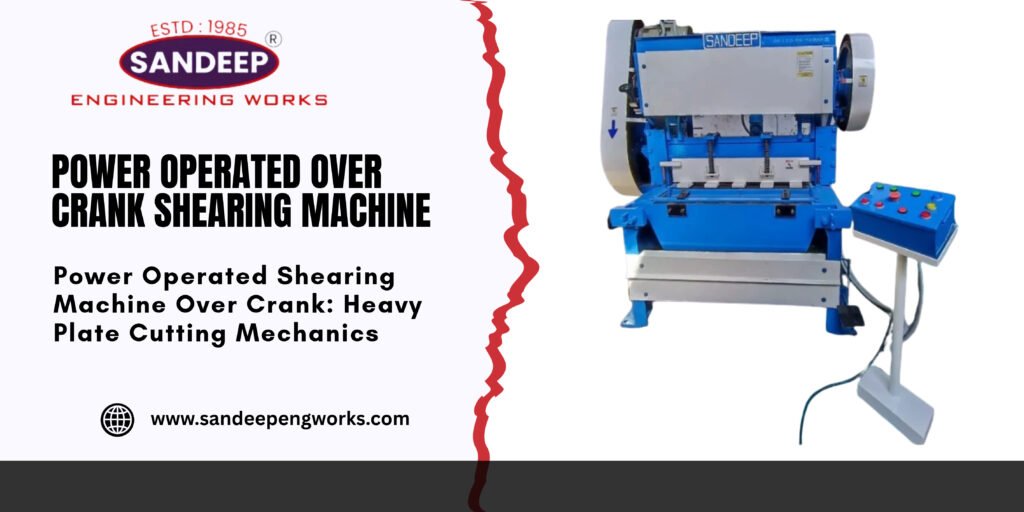
When sheet metal fabrication scales up from thin gauges into thick Mild Steel (MS) plates, high-tensile structural steels, and heavy Stainless Steel (SS) sections, cutting forces increase exponentially. Shearing a 10 mm, 12 mm, or 20 mm thick steel plate generates immense vertical and horizontal shock loads that demand superior structural mass, higher rake geometry, and direct downward force transmission. For these demanding heavy-engineering environments, the Power Operated Shearing Machine Over Crank serves as the definitive mechanical guillotine shear.
By mounting the crankshaft, eccentric eccentrics, and main drive gearing above the upper cutting beam rather than underneath the worktable, the over-crank design transforms how force is applied to thick plates. Understanding its overhead drive kinematics, steeper rake angle mechanics, heavy hold-down clamping physics, and unobstructed blade-bed accessibility explains why heavy fabricators rely on over-crank shears for thick-plate production.
1. Overhead Crankshaft Kinematics and Direct Downward Force
The defining engineering feature of an over-crank guillotine shear is the elevated placement of its crankshaft and connecting rod assembly at the crown of the side housings, directly above the reciprocating upper blade carriage:
Direct Push-Down Force Transmission: In an over-crank configuration, the electric motor drives a heavy balanced flywheel and multi-stage reduction gear train mounted high on the main frame. As the overhead crankshaft rotates, short, massive connecting rods push the upper cutting beam straight downward into the metal plate. Because the driving force acts directly in line with the cutting plane from above, bending moments on the connecting linkages are minimized even under extreme plate-shearing loads.
Heavy Structural Side Housings and Throat Depth: Positioning the drive mechanism overhead frees up the lower frame structure, allowing engineers to design massive, deeply ribbed side housings with generous throat depths. This throat gap enables operators to slit long plates continuously that exceed the nominal bed width of the machine—a critical requirement in structural steel yards and tank fabrication shops.
Longer Stroke Travel for Thick Plate Clearance: Over-crank shears are engineered with a longer vertical ram stroke than light-duty shears, giving the upper blade ample daylight above the lower bed to feed thick, slightly cambered hot-rolled (HR) plates smoothly without striking the upper blade edge.
2. Steeper Rake Angle Physics for Heavy Plate Cutting
The force required to shear a metal plate increases with the square of its thickness ($F \propto t^2$). Doubling plate thickness quadruples the required shearing tonnage if the blade angle remains unchanged. To cut thick plates cleanly without overloading the flywheel, clutch, or frame, an over-crank shearing machine relies on a steeper upper-blade rake angle.
Reducing Instantaneous Cutting Load: By inclining the upper blade at a more pronounced downward angle relative to the stationary lower blade, only a short horizontal segment of the thick plate is undergoing shear fracture at any single instant. This progressive scissor-like slicing spreads the total work over a longer portion of the crankshaft rotation, dramatically reducing peak tonnage demand and smoothing out energy draw from the flywheel.
Adjustable Rake Geometry on Heavy Models: On heavy-capacity over-crank shears, the upper cutting beam can often be adjusted for rake angle depending on the job. When cutting maximum-thickness plates, a steeper rake protects the drive train; when cutting thinner sheets on the same machine, reducing the rake angle minimizes strip bow and edge twist.
3. High-Force Hold-Down Clamping and Unobstructed Bed Access
Shearing thick plates generates powerful horizontal separating forces that attempt to push the upper and lower blades apart, as well as upward tilting forces on the plate tail.
Heavy-Duty Mechanical or Hydraulic Hold-Downs: Over-crank shears incorporate high-pressure hold-down plungers spaced closely along the front of the cutting beam. Engaging the plate milliseconds before the upper blade makes contact, these plungers anchor heavy hot-rolled plates firmly against the worktable, preventing plate kick-up and guaranteeing a perpendicular cut edge.
Open Lower Bed and Rapid Blade Maintenance: Because the entire crankshaft and gear assembly sits overhead, the region beneath the lower cutting table remains completely open. Technicians have unobstructed front and rear access to the lower blade seat, bed clearance adjustment bolts, and rear drop chute. Rotating four-edge reversible blades or performing feeler-gauge clearance checks across wide beds is faster and safer without lower-frame gear housings obstructing access.
4. Over Crank vs. Under Crank Architecture Across Shearing Systems
Within the complete family of industrial Shearing Machines, matching drive architecture to plate thickness prevents both under-powered stalling and unnecessary capital expenditure:
Heavy Plate Authority (Over Crank): The over-crank architecture is purpose-built for medium-to-heavy plates (typically 6 mm up to 20 mm and beyond), wide cutting spans, and high-tensile materials where downward push-force, throat depth, and steep rake geometry are paramount.
High-Speed Light-to-Medium Gauge Efficiency (Under Crank): Conversely, when a workshop primarily cuts thinner sheets (1 mm to 6 mm) at high strokes per minute and requires minimal strip twist on narrow off-cuts, a Power Operated Shearing Machine Under Crank or Mechanical Under Crank Shearing Machine offers superior cycle speed and a compact vertical footprint.
5. Industrial Sectors Powered by Over Crank Shearing Machines
Because of their rugged steel-plate construction and ability to shear thick alloys without thermal distortion, over-crank shears are essential equipment across heavy manufacturing industries:
Heavy Structural Steel and PEB Fabrication: Cutting gusset plates, base plates, web stiffeners, and flange blanks from thick hot-rolled mild steel plates.
Boiler, Pressure Vessel, and Storage Tank Manufacturing: Preparing heavy plate edges with clean, oxide-free square faces prior to plate rolling and submerged-arc welding.
Shipbuilding, Railway Coach, and Earthmoving Equipment: Shearing high-strength alloy steel plates for chassis frames, buckets, hulls, and heavy machinery housings.
Steel Service Centers and Metal Stockholders: Processing thick mill plates into custom-sized blanks with tight dimensional tolerances and zero heat-affected zones.
Heavy-Duty Over Crank Shearing Machines by Sandeep Engineering Works
At Sandeep Engineering Works, every Power Operated Shearing Machine Over Crank is fabricated from stress-relieved heavy steel plates and fitted with precision-ground EN-31 or HCHCR four-edge reversible blades, high-torque reduction gearing, and rigid hold-down clamping systems. Connect with our engineering team to discuss your maximum plate thickness, cutting width, and material grade requirements.
 Users Today : 2
 Users This Month : 9
 Total Users : 10