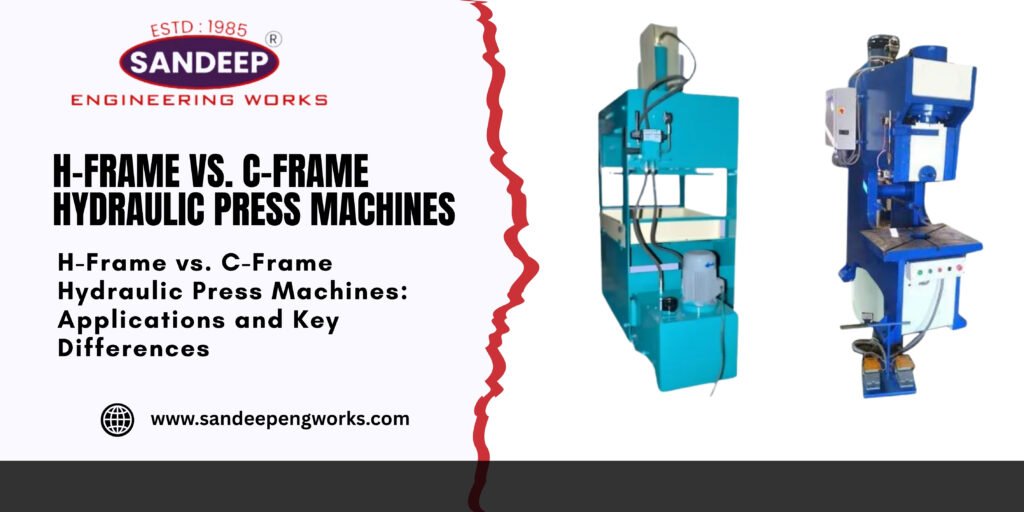
Hydraulic presses are the backbone of metal forming, straightening, bending, and assembly operations. When it comes to choosing the right press for your workshop, the overall frame design plays the biggest role in how the machine handles heavy loads and what kind of workpieces you can fit inside.
Two of the most common configurations in industrial manufacturing are the H Frame Hydraulic Press Machine and the C Frame Hydraulic Press Machine. While both use hydraulic fluid power to deliver massive force, their physical builds make them suited for entirely different tasks.
Understanding H-Frame Hydraulic Press Machines
An H-frame press gets its name from its sturdy, four-pillar structural shape that resembles the letter “H.”
-
Maximum Structural Stability: Because the hydraulic cylinder is centered within a balanced, four-post box frame, H-frame presses are built to handle exceptionally high tonnages without bowing or flexing.
-
Even Load Distribution: The enclosed structure ensures that pressure is distributed evenly across the entire working bed, making it ideal for heavy-duty pressing, deep drawing, and large component assembly.
-
Best Workshop Uses: Heavy metal straightening, bearing insertion, bushing removal, and large-scale industrial molding where maximum rigidity is required.
Understanding C-Frame Hydraulic Press Machines
A C-frame press features a single-column frame shaped like the letter “C,” which leaves the front and sides open around the work area.
-
Easy Access and Ergonomics: The open-side design allows operators to feed material from three sides, making it much faster for loading and unloading smaller workpieces.
-
Space-Saving Footprint: C-frame units typically take up less floor space, making them a popular choice for fast-paced assembly lines and smaller production shops.
-
Best Workshop Uses: Punching, riveting, bending, trimming, and high-speed assembly work where operators need quick, unobstructed access to the die area.
Key Factors to Consider for Your Shop
-
Tonnage and Force Requirements: If your work involves heavy, thick metals that require massive pressure, the rigid box construction of an H Frame Hydraulic Press Machine is the safer and more stable choice.
-
Speed and Part Handling: If you are producing thousands of smaller components that require rapid loading and unloading, the open accessibility of a C Frame Hydraulic Press Machine will speed up your daily output.
-
Workpiece Size: Consider the physical dimensions of your materials. Long or bulky parts often require the wide, unobstructed bed clearance found in multi-pillar frames.
Conclusion
Choosing between an H-frame and a C-frame press comes down to balancing structural strength against operator accessibility. By aligning your daily manufacturing needs with the right frame design, you ensure maximum safety, precision, and efficiency in your workshop.
Explore our robust range of H Frame Hydraulic Press Machine models for heavy industrial pressing. Check out our versatile C Frame Hydraulic Press Machine units designed for fast, accessible assembly work.