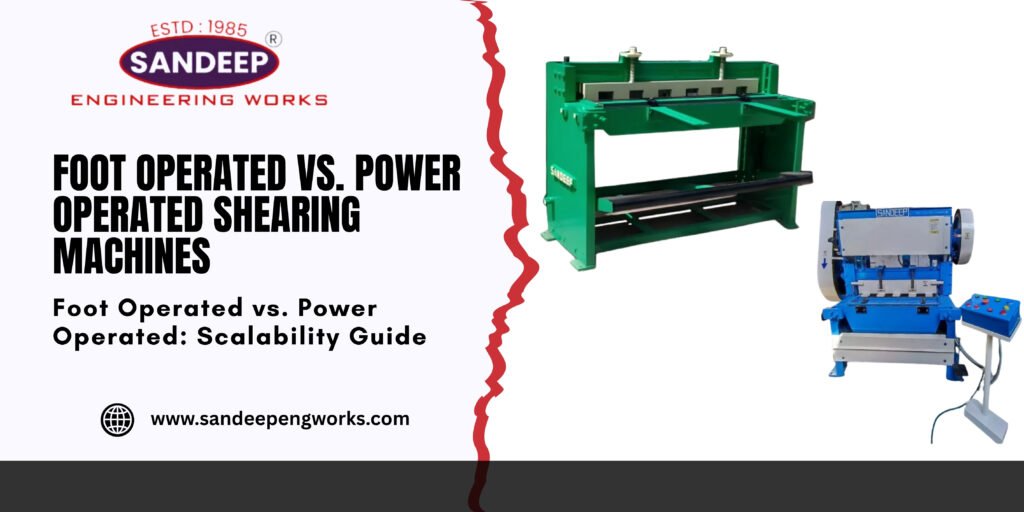
Scaling a metal fabrication business requires more than just finding new clients—it requires the right infrastructure. As your order volume increases, you will inevitably reach a point where your existing machinery can no longer keep up with demand. The question then becomes: when is the right time to transition from a foot-operated shearing machine to a power-operated shearing machine?
In this guide, we analyze the transition phase of industrial fabrication to help you make a smart investment for your company’s growth.
Understanding the Capabilities
For many startups and small-scale workshops, the Foot Operated Shearing Machine is the starting point. These machines are excellent for precision, low-energy usage, and handling lighter gauges of metal. Because they rely on manual input, they allow for meticulous control, which is great for specialized, small-batch components.
However, as production ramps up, the physical limitations of the operator become a bottleneck. This is where Power Operated Shearing Machines enter the picture. Designed for high-speed, consistent throughput, these machines remove the fatigue factor, allowing your team to maintain the same level of productivity at the end of the shift as they had at the start.
Scaling Factors: When to Upgrade
1. Throughput Capacity
If your operators are spending more time on the shearing process than on the assembly or welding phase, your shearing machine is likely hindering your industrial production scaling. Power-operated shears drastically reduce cycle times, allowing you to process more sheets per hour.
2. Material Gauge Requirements
Foot-operated shears are typically limited by the physical strength of the operator when cutting thicker sheets. If your project pipeline is moving toward heavier-duty structural components, a power-operated system is a necessity to ensure consistent, clean cuts without causing operator fatigue or machine strain.
3. Precision and Consistency
When you scale, your clients expect higher consistency across larger orders. Power-operated machines provide a uniform cutting force that manual machines struggle to match over long, repetitive cycles. This consistency is vital for maintaining high workshop productivity as you take on larger contracts.
Workflow Integration
Transitioning from manual to power doesn’t just change the speed—it changes the metal fabrication workflow. A power-operated machine allows you to set up jigs, back gauges, and production stops more effectively. This creates a repeatable process, which is the cornerstone of a scalable business model.
At Sandeep Engineering Works, we have helped hundreds of workshops transition their setups. Our goal is to ensure that your machinery grows alongside your business, providing the structural integrity required to handle modern production demands.
Ready to Scale Your Production?
Growth is a sign of success, but it requires the right tools. If your current shearing process feels like a limitation rather than an asset, it might be time to discuss your options with our engineering team. Explore our range of Shearing Machines or Contact our experts today to determine the best equipment path for your workshop's expansion.