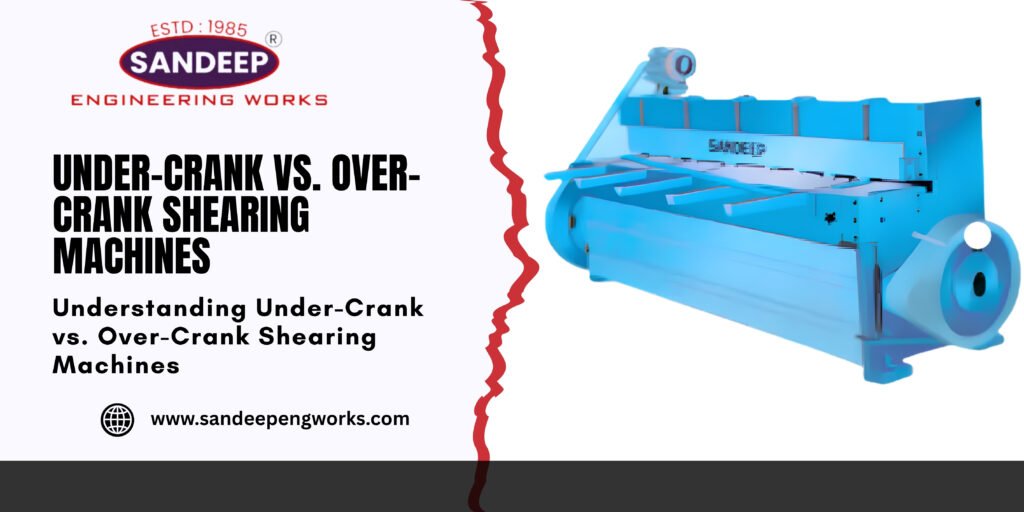
When browsing for heavy-duty metal fabrication equipment, you will often encounter technical terms that describe the machine’s internal architecture. Two of the most common terms you will see are “Under-Crank” and “Over-Crank.” While both designs serve the same ultimate purpose—cutting sheet metal—they operate using different mechanical configurations that affect performance, stability, and maintenance.
At Sandeep Engineering Works, we believe an informed buyer is a successful business owner. Here is a breakdown of these two drive mechanisms to help you choose the right configuration for your production needs.
The Mechanical Difference
1. Under-Crank Shearing Machines
In an Under-Crank Shearing Machine, the drive mechanism (the crank, flywheel, and gear system) is located beneath the working table.
Stability: Because the heavy driving components are located at the base, these machines often have a lower center of gravity, which contributes to excellent machine stability during heavy cuts.
Accessibility: The top area of the machine is cleaner, providing better visibility for the operator to align the sheet metal accurately.
Best For: These are highly favored in industrial settings where vibration reduction is a priority for high-precision metal cutting.
2. Over-Crank Shearing Machines
In an Over-Crank Shearing Machine, the drive mechanism is positioned above the cutting beam.
Design Simplicity: This design is often considered more traditional and straightforward for certain types of maintenance, as the main drive components are easily accessible from the top or sides.
Force Application: The downward force is applied directly from the top, which some fabricators find efficient for specific shearing angles.
Best For: Shops that prefer a classic mechanical layout and need a reliable, heavy-duty workhorse for standardized sheet metal fabrication.
Which One Should You Choose?
The choice between under-crank and over-crank often comes down to your shop’s specific workflow and maintenance preferences.
If your priority is machine stability and minimizing vibrations during heavy-duty cuts, the Under-Crank design is frequently the top choice for modern industrial fabricators. On the other hand, if you are looking for a tried-and-tested, classic mechanical architecture that your maintenance team is already familiar with, the Over-Crank design remains a staple in workshops across India.
Need Technical Guidance for Your Workshop?
Selecting the right machine architecture is a key step in building a high-efficiency fabrication line. If you are unsure which configuration will best handle your daily material throughput, our technical team is here to guide you.